
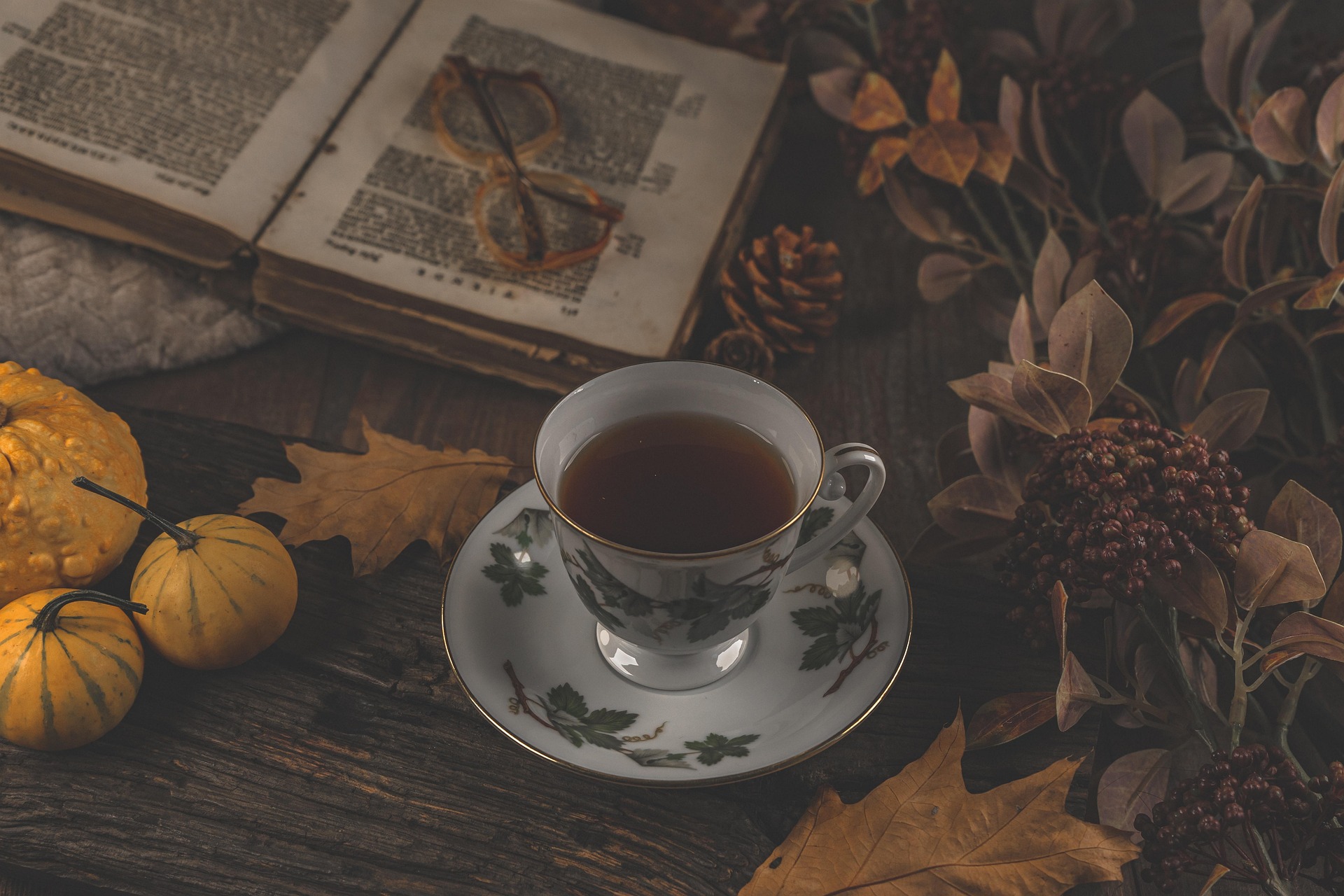
It’s officially autumn. As I’m writing this, here in Sacramento, even though it’s still uncomfortably warm, the temperatures are definitely trending downward, we’ve gotten the first rain of the season, and there’s definitely an air of Halloween. Pumpkin patches are open, Starbucks pumpkin spice is flying, and people are already posting complaints about their 12-foot fake skeletons getting knocked over like some kind of urban cow-tipping ritual. These are my local guideposts to the coming of Samhain.
But what does anything of this have to do with Samhain? Nothing – not really – but part of observing seasonal changes is by keying into the things in your culture and environment that change with the seasons – so here we are.
But joking aside, there is joy and mirth to be found around Samhain, because most of the fun childhood Halloween traditions that we carry more and more into adulthood are actually rooted in some of the original celebrations of Samhain.
Samhain? Not Halloween?
Much like Beltane, which falls between the Spring Equinox (mid-late March) and the Summer Solstice (mid-late June), Samhain falls between the Autumn Equinox (September) and the Winter Solstice (December). Though, October 31 isn’t anywhere near midway between the Equinox and the Solstice. Calendar shifts, religious interventions, and whatever else humans decided to tinker with along the way have made pinpointing the “true” date of Samhain . . . complicated, to say the least.
There is evidence that the ancient fire festival that eventually became Samhain began upwards of 2,000 years before the Celts arrived – though they’re often the ones who get the credit. It may also have been the origin of the idea of the veil being thin, as the nights of Samhain and Beltane both “. . . did not belong to the old year nor the new. It could be said that time stood still on this night, and the implications of this were immense” (Newgrange).
Basically, humans have been freaking out about death, ghosts, and liminal time for a long time.
As the Celtic New Year, Samhain has, in modern times, earned the nickname the Witch’s New Year. Samhain morphed into the Halloween most of us know over time, and the Celtic New Year quietly became a turning-of-the-year moment for Witches who still honor its deeper rhythms. As with all Pagan traditions and Witchcraft practices, the myths and rituals that mark Samhain are living, breathing things. It is ancient, messy, magical, and very much still happening.
Origins and the Wider Context
Celtic and European Roots
Want strawberries in December? Sure. Pumpkin spice lattes in July? Absolutely – as long as you’re willing to make it yourself. But in pre-industrial times, the ancient Celts didn’t have Amazon Prime or Starbucks on every corner. Their calendars revolved around the cosmos and the effects of solar and lunar cycles on the land. These cycles dictated the growth and waning of fertility, and Samhain marked the final harvest.
The Hill of Tlachtga at Boyne Valley, Ireland is believed to have been the original home of the “Great Fire Festival” (Newgrange) that became Samhain. Fire was seen as “the earthly counterpart to the sun,” and at Samhain – when the sun was off vacationing in the Underworld and underworld denizens got to roam the earth – bonfires were lit to lend the fading sun a little extra oomph so that it, and the fertile times, would come again.
Samhain was also a night for spirits, ancestors, and community – wherever the origins of those themes came from. It marked the threshold between the old year and the new, lending weight to the belief of a thinning veil, allowing spirits to walk among the living. Today, we wear costumes for fun, but back then, they were meant both to scare off malevolent spirits, and to disguise people as one for protection. Trick-or-treating has similar roots – households left treats to appease these wandering spirits, lest they be left with a trick if they came up short.
The Christian overlay and Secular Halloween
When Catholicism rolled into Britain to convert the locals, the Church decided Catholic saints would be added to the celebrations. October 31 became All Hallows’ Eve, the night before All Saints’ Day on November 1, a time for Hallow Mass where parishioners would pray for the dead. Over time, All Hallows’ Eve got its nickname shortened to the snappier “Halloween.”
The jack-o’-lantern story isn’t exactly Samhain-specific – it comes from broader Celtic folklore. The gist: a man named Jack tricked the Devil so many times that he eventually became cursed to wander the earth with only a burning coal in a carved turnip to light his way. When Irish immigrants arrived in America during the “Great Potato Famine”, they switched to pumpkins, which were far easier to carve.
After World War II, Halloween increasingly became a kid-centric holiday of costumes and candy. By the 1970s, adults wanted in too, and the trend of more elaborate – and racy – costumes took off. Today, Halloween is a globally celebrated holiday, and in the U.S. alone, it’s a $12 billion industry.
The global echoes
Although Samhain is definitely European in origin, its themes are practically universal – like pumpkin spice in September, they show up everywhere. You can see it holidays focused on honoring ancestors, and in countless cultural traditions that still mark the end of the harvest from late September through October. Humans all over the world have been celebrating “let’s eat, remember the dead, and maybe light some fire before it gets fucking cold” for millennia. Here are just a few examples of cultural traditions around ancestral veneration, spirits, and end of season feasting that have persisted alongside Samhain.
Probably the most widely recognized parallel is Día de los Muertos (Day of the Dead), celebrated across Mexico and by people of Hispanic descent worldwide. Similar to how Samhain got a makeover when Catholicism arrived in Britain, Día de los Muertos began with indigenous traditions and later blended in Spanish Catholic influences.
In Guatemala, November 1 brings the Festival de los Barriletes Gigantes, or Giant Kite Festival. Its origins feel familiar: malevolent spirits would appear in cemeteries to disturb the peace, so the elders of Sumpango figured out that the noise of wind and paper forced these spirits away, giving rise to the creation of enormous kites.
In pre-colonial Philippines, there was a tradition that literally translated to “haunting.” On the night before Todos los Santos (All Saints Day), people draped themselves in white and traveled from home to home singing, pretending to be spirits. Much like the origin of trick-or-treating, households would pray for the wandering spirits and offer rice cakes, or kakanin, to take back to the land of the dead.
Seasonal, Natural, and Communal Significance
By the time Samhain season rolls around, daylight and nighttime are no longer equal. The final planting has borne its last fruits, and what’s left on the vine has begun to decay, returning to the soil to nourish next year’s growth. There is nothing left to harvest from the earth at this time; she is settling into her deep, restorative slumber.
Animals that wouldn’t survive the winter were slaughtered for food. Crops and animals would be offered in fire as both sacrifice and thanks, while the community danced around the bonfire. As days grew shorter and colder, time spent together outdoors dwindled, making this festival not only spiritually and agriculturally important, but a vital moment of community.
Around the world, people celebrate Halloween alongside localized, historically rich practices that honor ancestors, communities, and the natural rhythms of the land. Despite christian conquest and colonization, these traditions have persisted despite attempts at assimilation or outright eradication. Samhain isn’t just about the ancestors or spooky spirits – it’s about community, and the ability to endure intact through long periods of darkness and isolation. For these communities, Samhain was both a celebration and a reminder: even as the world outside grew darker, the warmth of community and tradition could carry them through.
Spiritual and Magical Themes
Liminality and the cyclical thinning of the veil
The “veil” – that unseen boundary between our world and the spirit world – thickens and thins within the cycle of the seasons. Samhain and Beltane share this thinning, but their energies differ: Beltane bursts with expansion, new life, and fertility, while Samhain is about contraction, returning to the Earth, and embracing the decay necessary for future growth.
Death and rebirth
Anyone familiar with the Fool’s Journey in tarot knows that Death is rarely literal – it’s an archetype. The Death card channels the energy of Samhain: the natural ending of things, death as a part of the cycle of life, ending as beginnings. Transformation – through natural cycles, intentional work, metamorphosis, or personal alchemy – leads to renewal and new beginnings. It’s not about resisting an end, fully embracing it. It’s accepting the process. It’s the conscious act of letting go.
Letting go isn’t always about people, memories, or old habits or ways of thinking – it’s anything that once shaped us but no longer serve our growth. Butterflies can’t fly if they linger in their chrysalis – they will eventually suffocate if they don’t break free from the container of their transformation.
Endings aren’t comfortable, but neither is staying stuck in a skin that no longer fits. Samhain reminds us that the only way forward is through the shedding, however messy it gets.
Ancestors and chthonic deities
‘Ancestors’ can mean different things, depending on your perspectives, experiences, stage of life. As a Witch, you carry far more than just your biological lineage – you also carry the ancestors of your craft. The teachers of your teachers, the Witches who fought for our right to exist in peace – these are your ancestors in the craft.
Ancestors don’t always come neatly stamped in DNA, either. They arrive through adoption, chosen family, ethnicity, culture, or any influence you claim for you are today. If it shaped you, you can add it to your ancestor file – and these ancestors still guide you and protect you, even if they weren’t aware of your existence when alive.
If your practice is more devotional and less ancestral, there are plenty of chthonic deities to work with during Samhain season. “Chthonic” literally is defined by Merriam-Webster as “of or relating to the underworld”. And even dictionaries know “chthonic deities” run the show down there. No matter your pantheon, there’s almost certainly at least one underworld deity ready for connection.
If you don’t already have an established relationship, it’s wise to get to know them a bit before diving in. For example, working with Orcus may not be ideal if you recently broke a significant promise – be that cheating on a monogamous partner, or forgetting a long-promised outing with your kid, or otherwise failing to honor someone’s trust.
Devotional work, like comedy, is a lot about timing. Appropriate timing can be the difference between a profound mystical experience and a very awkward conversation in the underworld.
Symbols and Correspondences
This section will be brief in comparison, as this is mostly things that represent the different themes and energies of Samhain, which we already covered, and will simply be focused more on how they can be used in that context.
The Samhain altar
Ancestral keepsakes and photos help set the intention for an altar dedicated to your ancestors – and they also gently pull your attention and energy toward them whenever you’re at or near the altar.
Leave offerings of seasonal foods to invite your ancestors, spirits, or deities into the space.
Bones, skulls, candles, and a cauldron can symbolize the transformation of your ancestors from physical form into spirit, honoring their journey while reminding us of the cycles of life and death.
Dark cloths, autumn leaves, gourds, and nuts help decorate the space for the season, making it warm and inviting – a little autumnal welcome mat for those who’ve gone before.
Use the color black to represent death, decay, mystery, and the creeping dominance of night. Orange is for the changing leaves, the harvest, and the warmth of fire, while red represents blood, vitality, and the fierce energy of flame. And gold stands for the waning sunlight and the rich, golden bounty of the harvest.
Final Harvest Foods
Apples, nuts, root vegetables, grains and winter squash all have varied harvest windows, depending on the variety. So, while one kind of apple could be harvested mid-September, another could be harvested during the final two weeks of October.
Preserved foods – jams, jellies, pickled items, dried fruits and herbs, jerkies, or anything prepared to last through the winter are also appropriate for Samhain. These are perfect for honoring the season’s bounty and keeping your ancestors well-fed (or at least well-remembered).
Tools with Samhain resonances
Use the cauldron to represent transformation and the womb of rebirth, divination tools to help you glimpse beyond the veil, candles to honor and connect with the departed, and bowls to hold offerings to your ancestors, and any other deities or spirits you work with.
Rituals and Practices
Not everyone has the same access to community, tools, mobility, or even the tolerance for certain scents and foods. Many times, rituals that seem to require movement, noise, or an altar that doubles as an Instagram photoshoot can be done right where you sit. You can create an inner sacred space – so if you can’t set up or use a physical altar, you can still perform rituals using meditation and visualization.
And ritual doesn’t have to be big, loud, or smoky. Unscented or LED candles, wax warmers, or oil diffusers all work just as well – sometimes better if you’ve got roommates, pets, kids, or a smoke detector that thinks it’s your high priestex. Witchcraft doesn’t belong to the able-bodied or the neurotypical. Witchcraft belongs to all Witches.
Traditional Practices
If you can do so safely, lighting a bonfire with friends, your coven, or your family is a great way to bond – and call in the protective element of fire for the coming darkness and the year ahead. Bonus: marshmallows are optional, but highly encouraged.
Offerings of the final harvest – or foods made from them – can be left for your ancestors. You can even try a Dumb Supper: a silent meal honoring the ancestors. This is your chance to give them a voice without letting anyone talk over them – while also honoring those still living who are being actively silenced.
With the thinning of the veil, Samhain is also a prime time for divination. Use apples, herbs in tea, scrying mirrors, tarot, bones or runes – any form of divination you’re comfortable with. Haven’t tried divination before? Samhain is a perfect excuse to start. Consider it the universe handing you a “get mystical” permission slip.
Modern practices
Samhain, with its focus on death, dying, and decay provides us with an excuse to get down and dirty with our demons. This can be as simple as journaling around something about ourselves we usually cringe away from (yes, we were all assholes as children – let’s just acknowledge it), or diving face-first into tending grief that has festered past the point of reasonable consumption.
If the kitchen is your stage, put seasonal foods – especially of the final harvest – front and center. Press your own cider, dust off that old crock pot for mulled wine, bring your pumpkin spice A-game to baked breads or donuts, or get a head start on apple or pumpkin pie. Who needs a colonial holiday like thanksgiving, when you have Samhain?
Got a pesky ex who won’t leave you alone? Banish them! A bad habit you can’t seem to kick? Cut the cord to that bitch. Clinging to an old grudge or pain that haunts you? Call in your ‘healed and whole’ ancestors – they know how to handle the heavy stuff and can help you leave it in the metaphorical dust. While the secular New Year is all about planning ahead, Samhain is your “bye, Felicia!” to the year gone.
Activism is right on brand with the community themes of Samhain. The ‘whole and healed’ ancestors show that shedding racist, queerphobic, ableist mindsets and moving toward understanding and inclusivity is fucking powerful. What better way to help the living make those changes than to call on the wisdom and energy of ancestors who have already done the work?
Most importantly, for those of us in colonized spaces: honor the ancestors of place. Some progress has been made toward returning land to the care of those who’ve always cared for it – the people with deeper, older ties to it than most of us can even begin to comprehend – but “better” doesn’t mean “done,” or even “good.”
How do we honor those ancestors? We learn about them. We connect with their living descendants and communities – respectfully, and without centering on ourselves. Participate in the work that will return the land, the stories, and the power back to those ancestors it was taken from through violence, deceit, and centuries of erasure and colonization.
How to Celebrate Samhain
Simple
Witchcraft doesn’t need to be complicated or grandiose – and at this time of year, everything else in nature is hitting the brakes. You can still honor Samhain just as deeply and meaningfully as any other Witch even if your energy, budget, or motivation levels are “barely sentient houseplant.” The magic doesn’t care how fancy you get, just that you show up.
Even if you’re in the grip of full burnout, you can –
- Light a candle with intent – even an LED one will do (spirits don’t check wattage). Use candle common sense if you use a live flame.
- Say a prayer for your ancestors. Bless those who’ve healed, pray for those who still need it, or just acknowledge that their choices – good, bad, and bewildering – eventually led to you.
- Send blessings to your friends and family for the dark months ahead. A quick prayer, text, or voice message – even an appropriate meme – can do the trick. Nothing says “may you be protected in the long winter ahead” like a perfectly timed skeleton joke.
practical
If you want to be more mindful and intentional in your day to day – possibly while flying under the radar of the ancestors-to-be who haven’t healed yet – Samhain can be honored in the small, intentional ways you move through your day.
- Use final harvest foods when you cook.
- Put a spin on trick or treat, and Make something tasty to share with your community – physical or digital.
In-Depth
Doing things more in-depth doesn’t require having access to props, or even being able to get out of bed. Anything that can be done in your external sacred space can be accomplished in your own inner sacred space. Anything from a full ritual to a Dumb Supper can be done in either case. Or, invite friends and family into sacred space for community magic. Ritual and community magic can be anything from writing letters to the ancestors, to deep, internal shadow work meant to bring you to and through a liminal, transformative space.
In Closing (Much Like the Year…)
Samhain is a threshold. It’s the end of one year and the beginning of the next. It’s The World reshaping itself into the tools of The Fool. It’s the fading of life and light to give way to the sacred, silent dark – where new life germinates. It’s connecting and reconnecting with family and community, present and passed. It’s the renewal – or the beginning – of an ancestral practice.
The threshold of personal + community work, and reflection and action are just as present and alive. There is a breath of potential that hums through the world. So take care of yourself, so you can help hold your community steady. Your magic belongs in the world, for you are Witch. The old adage still holds true: “as above so below, so within, so without.” Or as I’ve learned to say when creating sacred space: “we are between the worlds, and what happens between the worlds, changes all the worlds.”
Don’t ever let yourself believe that you can’t make a change. It may be feel small, but a mountain is made of a million tiny pebbles, and the ocean of a million tiny drops. It takes everything – from the tiniest effort to the mountainous – in order to build a world we feel safe to live in. And if that’s not Witchcraft in action, I don’t know what is.
Sources
These are sources I either referenced directly in this post (such as Newgrange), or that I found to have good information on the history and modern practices of Samhain.
Artio, Mòrwenna. “Samhain Tide – 13 Nights of the Witch.” Wildera Art · Blog, 27 Nov. 2020, https://wildera.art/blog/samhain-tide/.
Black, Susa Morgan. “Deeper Into Samhain/Samhuinn.” Order of Bards, Ovates & Druids, 1 Nov. 2023, https://druidry.org/druid-way/teaching-and-practice/druid-festivals/samhain-festival.
Campued, Brian. “‘Pangangaluluwa’: Filipino-Style Halloween.” PTV News, 30 Oct. 2024, https://ptvnews.ph/pangangaluluwa-filipino-style-halloween/.
“CHTHONIC Definition & Meaning.” Merriam-Webster: America’s Most Trusted Dictionary, https://www.merriam-webster.com/dictionary/chthonic. Accessed 28 Sept. 2025.
Dahm the Bard. A Samhain/Sauinn Song. https://druidry.org/druid-way/teaching-and-practice/druid-festivals/samhain-festival.
Eastwood, Luke. “Tlachtga And The Ancient Roots Of Halloween/Samhain.” Order of Bards, Ovates & Druids, 11 Mar. 2020, https://druidry.org/resources/tlachtga-and-the-ancient-roots-of-halloween-samhain.
Gilroy, John. Tlachtga. Pikefield Publications, 2000.
Krystle. “Samhain: Witches, Winter & A New Year.” The Wholesome Witch, 6 Oct. 2017, https://www.thewholesomewitch.com/samhain-halloween-sabbat/.
Poe, Edgar Allen. “Spirits of the Dead.” Poetry Foundation, 1827, https://www.poetryfoundation.org/poems/48632/spirits-of-the-dead.
“Samhain / Samhuinn – Rituals & Traditions.” Order of Bards, Ovates & Druids, 1 Nov. 2023, https://druidry.org/druid-way/teaching-and-practice/druid-festivals/samhain-festival.
“Samhain (Samain) – The Celtic Roots of Halloween.” Newgrange World Heritage Site : Boyne Valley, Ireland, https://www.newgrange.com/samhain.htm. Accessed 28 Sept. 2025.
Witchwood, Leandra. “Samhain, The Witches New Year.” The Magick Kitchen, 2014, https://www.themagickkitchen.com/samhain-witches-new-year/.
Leave a Reply